Odysseus Talks With Teiresias and His Mother in the Underworld

💡 This is a chapter from Evergreen Stories by W. M. L. Hutchinson ← Go there to read the full book free online; it is also available in paperback and Kindle editions.
But Odysseus slept little that night, and at peep of dawn he stole out of Circe’s chamber and went softly through the house and, awaking his comrades, bade them follow him quickly, for still he had misgivings that her mood, as she had said, might change. And the crew, overjoyed, made haste down to the shore and the cave where they had laid up the ship. But for all their speed, the witch had been there before them and returned again to her house — nay, she passed them as she returned, though they saw her not, for she walks invisible when she pleases. And behold, the ship lay on the beach ready for launching, and a black ram and a black ewe were tethered to her side. The men cried out for wonder; then one said: “But what do we want with these two sheep? We can neither kill nor cook them on board.”
“They are for sacrifice,” answered Odysseus, “at the place whither we go.”
And thereupon he told the crew whither they were bound, and all Circe’s bidding. Bitterly they wept, and loudly they protested that it were better for them to die at once than go on that voyage; yet seeing there was no help for it, and being in great fear of the witch’s anger, they presently launched the ship and hoisted sail. And the wind she had promised drove them swiftly westward, till they passed through the gates of the Midland Sea and out into the great ocean stream that girdles the round world.
After the sun had set, they came to a land whereon he never shines, but fog and mist cover it from year’s end to year’s end, and its folk, who are called the Cimmerians, live in perpetual gloom. As the ship drew near that darksome coast, the wind fell suddenly; and Odysseus saw the place Circe had told him of, the willows dry and sere and the poplar grove. There he landed and made two of his comrades bring the black ram and ewe ashore, and set about the rites that she had bidden him perform.
First, going a little way into the poplar grove, he dug with his sword a shallow pit in the earth, a cubit square, and into this he poured a three-fold drink offering to the dead — firstly milk and honey, next wine, lastly pure water. Then with his sword he cut the throats of the two sheep, holding them close to the pit so that their blood flowed into it. Instantly there came a mingled sound like the rustling of leaves and the sighing of wind and the twittering of birds, and ghostly forms were seen thronging near — forms of maidens, and old men, and warriors in bloodstained armor, and many others. At that, the hair of Odysseus and the two men with him rose on their heads and their teeth chattered for fear, but he mastered himself and said: “Quick, comrades, take the carcasses of the sheep and go back to the beach. Make a fire there and burn them, and pray the gods of the dead to accept the sacrifice.” And the two made haste to obey.
Now Circe had told him that the ghosts would come flocking to drink out of the pit —for they are athirst for life, and a draught of warm blood puts life into them a little while— but that he must keep them off with his sword and not suffer any to drink until Teiresias had come and taken his share. So there he stood on guard, waving the gleaming blade this way and that way; and the ghosts drew back, gibbering — for they cannot endure to look on iron or steel. Then suddenly stepped forth one who seemed no phantom but alive; Odysseus knew him and cried: “Elpenor! In the name of wonder, how came you hither, faster than our ship has sailed? In the hurry of departing, no one missed you from amongst us until we had put to sea. But doubtless here is some witch work of Circe’s.”
“Not so, Odysseus,” answered Elpenor in faint, hollow tones — and even as he spoke, the hues of life began to fade from his visage, and his form to grow shadowy like those others. “Not so,” he said again. “I am come to this land of the dead because I am one of them. I died but a few moments after you left the house of the witch. Nay, start not, Odysseus — ’twas by no violence or treachery, but my own heedlessness… Last night, being heated with wine, I went up to the palace roof to sleep there in the cool. I woke suddenly, before it was yet daylight, and heard your voices and footsteps going away. And I leaped up to follow — but forgetting where I was, nor seeing in the dimness the trapdoor and the ladder by which I had gone up, I fell headlong from the roof and broke my neck… But, oh, my captain, I conjure you, as ever you hope to see home and loved ones again, forget me not when you return to Circe’s isle — for return you will, I know. Let me not lie there unburied, unwept for, but burn me and mine arms on a funeral pyre, with dirges due. Then heap a mound over my bones, by the seashore, and set up my oar thereon —the oar I toiled at long among my comrades— that mariners passing by may know ’tis a sailor’s tomb and pity him his death far from home.”
“All this shall be done as you wish, hapless one,” said Odysseus, much moved. Then Elpenor departed, nor looked behind him as he went.
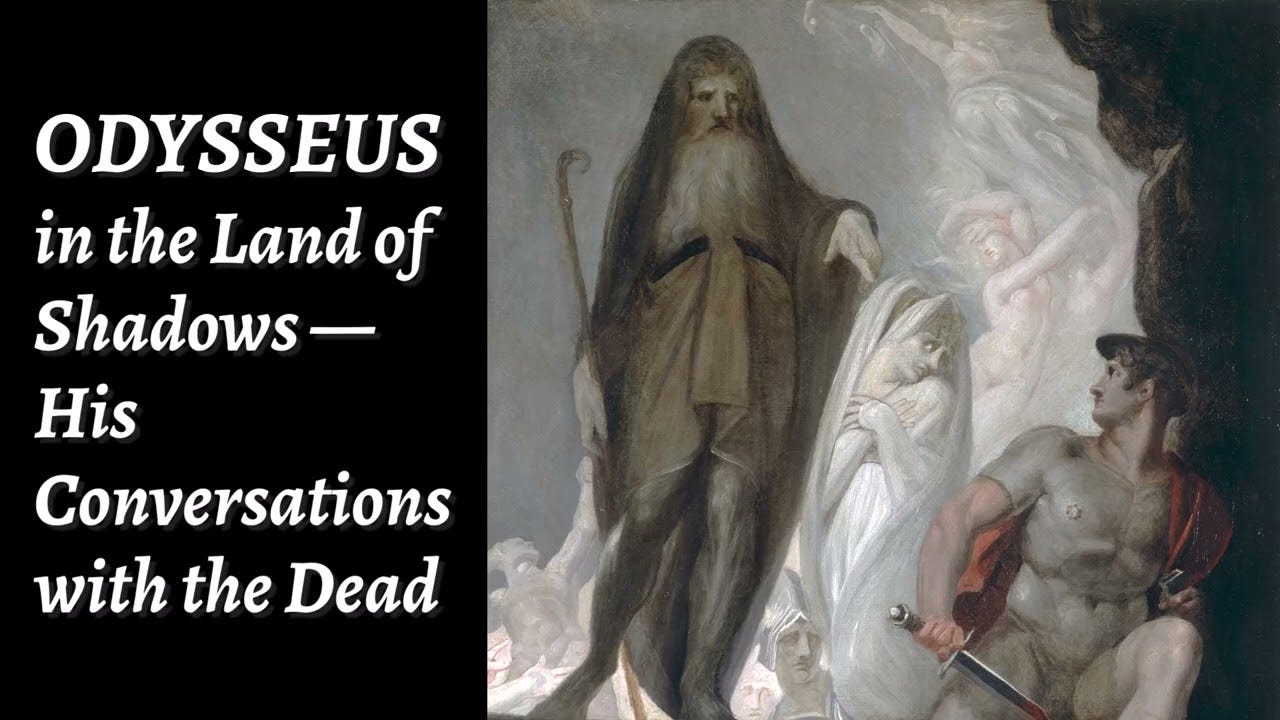
And now among the hovering faces near Odysseus saw that of his mother, whom he had left alive when he sailed for Troy. Sorely he wept at that sight; much he longed to let her come near, but dared not lower the sword till Teiresias should come. Immediately after, a tall, majestic old man drew near, for whom the other souls made way with reverent looks. He held a golden scepter in his hand, and by his white chaplet and seer’s mantle Odysseus knew this was Teiresias at last.
“Son of Laertes,” said the seer, “why hast thou quitted the light of day and come unto this realm of the dead, where no joy is? If it be to hear soothsay of me, stand away from the pit that I may drink of the blood, and put up thy sword into the scabbard.”
Then Odysseus sheathed the sword, and Teiresias stooped down and drank. But the other souls held aloof, reverencing the great seer. He, when he had drunk, began to speak thus:
“Thou art come to inquire of me, Odysseus, concerning thy homecoming, whether it shall be accomplished. Know, then, that much toil and many perils are yet in store for thee, for thou hast a mighty adversary, even Poseidon; yea, hot and quenchless is his wrath against thee for the blinding of the Cyclops, his son. Therefore, he has vexed thee with all his storms and, wert thou not protected by others among the immortals, he had wrecked thy ship ere now. As long as thou sailest the seas, he will be ever on the watch to do thee a mischief. Yet for all this thou mayest come safe home if thou heed the warning I now give thee…
“Thou comest from Circe’s isle — ay, ’twas that powerful enchantress, daughter of the sun god, who sent thee unto me, and to her thou must return. Fear nothing — she will let thee go as soon as she has given thee good store of all things needful for thy homeward voyage. Also, she will tell thee what course to steer, and of three strange perils that await thee thereon, and how to escape them. But now mark heedfully what I shall say…
“Those perils past, thou wilt come to the island called Trinacria, where there are seven herds of kine and seven flocks of sheep that belong to Helios the sun god. If thou and thy comrades lay no hand on these, then shall ye all return safe to Ithaca. But if not, all that have shared in that sacrilege shall perish at sea. And if thou thyself escape that doom, yet shall thy homecoming be long delayed and very grievous unto thee, for thou wilt return alone, in a ship borrowed from strangers, having lost thine own vessel and all thy comrades; and thou shalt find sore trouble at home — even men of violence lording it in thy house, wooing thy wife and devouring thy substance.”
At these words, Odysseus laid his hand on his sword hilt, and his grey eyes kindled.
“And shall I not take swift vengeance on those men,” he asked, “and set my house in order?”
“Ay,” said Teiresias, “that thou wilt do, whether by craft or in open fight. But soon thou wilt weary of dwelling idle in thy petty kingdom — soon the lust of wandering and adventure will possess thee again. Then, oh, sailor, take thine oar upon thy shoulder and fare forth. Travel on and on, till thou come to a country so far inland that its folk know nothing of the sea, nor of ships, nor of oars, that are as it were the wings whereby ships fly, neither have ever tasted salt, the fruit of the sea. And this shall be a clear sign to thee that thou art come to thy goal — another wayfarer shall meet thee on the road and, beholding the oar thou bearest on thy shoulder, shall say: ‘This is some new sort of winnowing fan.’ Then plant thine oar in the ground and do sacrifice to Poseidon, for then will he be reconciled. After that, return thou home again and offer a sacrifice of a hundred oxen to all the gods. But know, lastly, that death shall come to thee at last in gentle wise, and not upon the sea; thou wilt die in a green old age, with thy folk dwelling peaceably about thee.”
Thus the Theban seer ended his prophecy.
Then said Odysseus: “So be it, Teiresias, for all these things the gods have ordained as it seemed good to them. But now tell me one thing more, I pray you. Yonder I see the spirit of my dead mother; look, there she sits nearest, gazing on the pool of blood, but me she neither regards nor speaks to. What can I do to make her recognize her son?”
Teiresias answered: “Those spirits only can hold speech with thee whom thou shalt suffer to drink of the blood.” And with that he departed to his own place.
Then Odysseus beckoned with his hand to the spirit of Anticleia, his mother; and she glided to the pit and drank. And straightway she knew him and cried out: “Oh, my son, what do you here, in the kingdom of Hades? For I see well that you are a living man. Troy fell long since, I know — have you not yet been home?”
Odysseus made answer: “Mother mine, I came hither to seek guidance from Teiresias of Thebes, and not yet have I revisited my home. Of a truth, sorrow, and trouble have been my portion since first I went with King Agamemnon to Troyland. But I left you there alive and hale — tell me, dear mother, how you died. Was it some wasting sickness or a sudden shaft of Artemis, the destroyer of so many women, that laid you low? And my father, and my young son — do they live and prosper, possessing what was mine, or have others despoiled them of it? And Penelope my wife is she true to me all this while or has she given me up for lost and wedded some princely suitor?”
Then said Anticleia: “My son, Penelope is a faithful wife and sits weeping for you day and night. And Telemachus your son holds his due place both in your house and in all assemblies of the folk, with whom he is in high favor. But your father, worn out by age and sorrows, has withdrawn from the city to a poor hut on an outlying farm of yours and lives there in the humblest fashion, evermore mourning for his lost son. As for me, ’twas neither slow disease nor the swift arrows of Artemis that killed me. No, I died of sheer longing for you, child of my heart; so sorely did I miss your loving ways and wise counsel in all household troubles.”
Then fain would Odysseus have embraced and kissed his dear mother. Thrice he sprang forward with outstretched arms and thrice his arms closed upon empty air.
“How is this, my mother?” he cried despairingly. “Nay, sure, you are not my mother, but a phantom that Persephone, queen of the dead, has sent me in her likeness.”
But the soul of Anticleia answered: “Thus it is with us who are dead, my son. We have no longer flesh and bones that may be grasped, for those have been consumed by the funeral fire. That which survives those flames is but the shadowy counterfeit of our living selves. Even such am I now, dear son. And so farewell — but if you will heed your mother’s bidding, return as soon as may be to the light of day and, when you come home, tell all that you have seen and heard to your wife.”