The Happiest Man — The Story of Solon, Croesus, and Cyrus

💡 This is a chapter from Evergreen Stories by W. M. L. Hutchinson ← Go there to read the full book free online; it is also available in paperback and Kindle editions.
Fear no more the heat o’ the sun,
nor the furious winter’s rages;
thou thine earthly task hast done,
home art gone and ta’en thy wages.Dirge in Cymbeline
Respice finem
My soul, sit thou a patient looker-on;
judge not the play before the play is done:
her plot hath many changes; every day
speaks a new scene; the last act crowns the play.Francis Quarles
“But,” said the little boy, when Herodotus had finished his story, “was it not very hard that Pheidippides should die, just when he was so happy? Was that the reward Pan meant?”
“To die when he was so happy,” repeated Herodotus, “happier than he could ever be again if he lived a hundred years… when his heart was throbbing with bliss so intense that it killed him… to pass away in that wonderful moment, with no pain. Yes, that was Pheidippides’s reward, for the gods themselves could give him nothing better. They could do only one thing more — they made him happy forever… Do you understand now, my child?”
“I think I do,” said Linnet thoughtfully. “Athens was saved — and he had helped… and then, to run so splendidly and tell all the people the good news… No, all that could never happen again. But, if Pheidippides had lived, he would always have remembered it, wouldn’t he?”
“And that would have made him happy, you think,” said Herodotus with a sigh. “Ah, child, may you never feel in coming years how truly said some ancient sage: ‘No sharper pain than to remember happier things in hours of misery.’ And those hours come, soon or late, to every man upon this earth. Why, even the heroes of old —men of a mightier race than ours and sprung from the gods— suffered griefs and troubles manifold; even Peleus and Cadmus, renowned above them all for their good fortune. You have heard of those two, I am sure, my Linnet — for nurses sing rhymes about them over children’s cradles.”
“Yes, my nurse used to do that,” said Linnet eagerly. “She sang a song that began:
May you be lucky, my baby dear,
as ever King Peleus and Cadmus were,
for the gods gave each a lovely wife,
health and wealth and a long, long life——
I forget how it went on, but there was nothing about their having any troubles, I know, nor who they were. Will you please tell me that story, sir?”
“Why, I think I had better not,” said Herodotus, smiling pleasantly, “for one thing, a poet named Pindar has told it so well already that when you are a little older you will be glad to hear it for the first time in his great verse. For another thing, though I love storytelling, I make it a rule to relate only what I have myself seen or what I have good testimony for believing to have really happened. Understand me — I do not say the marvelous tales of poets concerning the heroes of past ages are not true. Nay, I devoutly believe them, for my own part. But I will not put them forth to the world on my authority.”
“My friend,” interposed old Cephalus, who had been placidly listening all this time, “you do but bewilder the child when you talk thus. If you must speak of truth, testimony, and the like, address yourself rather to his grandsire. I, simple as I am, can make shift to understand your distinctions between one story and another; but ’tis no task for a boy of nine summers, forward though he is.”
“Your rebuke, my worthy host, is both just and well-timed,” answered Herodotus with unruffled good humor; “I bow to it, and will say no more.”
But thereupon Linnet protested with all the vehemence of a spoiled child:
“No, no, grandfather! I do understand — I want to hear more.”
“More about Peleus and Cadmus, little one?” asked Herodotus, with a laughing eye. “Well, if you must have it — after much tribulation, they were each wedded to a divine bride: Peleus, to Thetis, the sea god’s daughter; and Cadmus, to Harmonia, child of golden Aphrodite. And the gods who live forever sat at both wedding feasts and bestowed gifts upon the happy bridegrooms; and for Peleus on Mount Pelion, and for Cadmus in seven-gated Thebes, the divine Muses sang the marriage lay. And both those heroes, as the nursery rhyme has it, lived healthy and wealthy to a green old age. Yet mark — Peleus saw his only son, Achilles, perish in his flower at the great siege of Troy; Cadmus, through his daughters’ sin against the gods, saw his heir strangely murdered and ended his days in exile. Thus fared those two acclaimed favorites of the gods. Much less, my child, can ordinary mortals expect abiding good fortune.”
Then is nobody really happy?” asked Linnet wistfully.
“Nay, I said not so,” answered Herodotus, and, “The gods forbid!” exclaimed Cephalus, both at once.
“Come, do not look so downcast, little friend,” went on the former. “‘Tis my fault, I see; but you shall have another story to make amends — and the story will answer your question.”
At this, Linnet smiled again, and Herodotus thus began…
I
“There was a time, long ago, when the city of Athens was in great distress and disorder through the feuds and quarrels of her own citizens. The rich oppressed the poor, and the poor hated and envied the rich; the noble families quarreled among themselves, and some of them stirred up the commons to lawlessness, out of spite against their own kinsmen who were in authority. At last, weary of riots and bloodshed, the Athenians agreed to appoint some wise and upright man to frame a set of laws by which rich and poor might have equal justice, and their city be peaceably governed. And with one accord they chose one of their own citizens, whose name was Solon.
“Now Solon, being indeed a wise man, would not undertake this task until the Athenians had bound themselves by a solemn oath not to alter laws he gave them for ten years, except with his consent; which when they did, he forthwith took ship and sailed away to far countries, and there remained until the ten years were over. For he knew their love of change and that, if he stayed at home, they would try to force him to repeal his laws as soon as they grew tired of them. He had, moreover, a great desire to see the world and seek knowledge and wisdom from men of other countries; but nothing but the reason I have told you made him banish himself all those years from his own city.
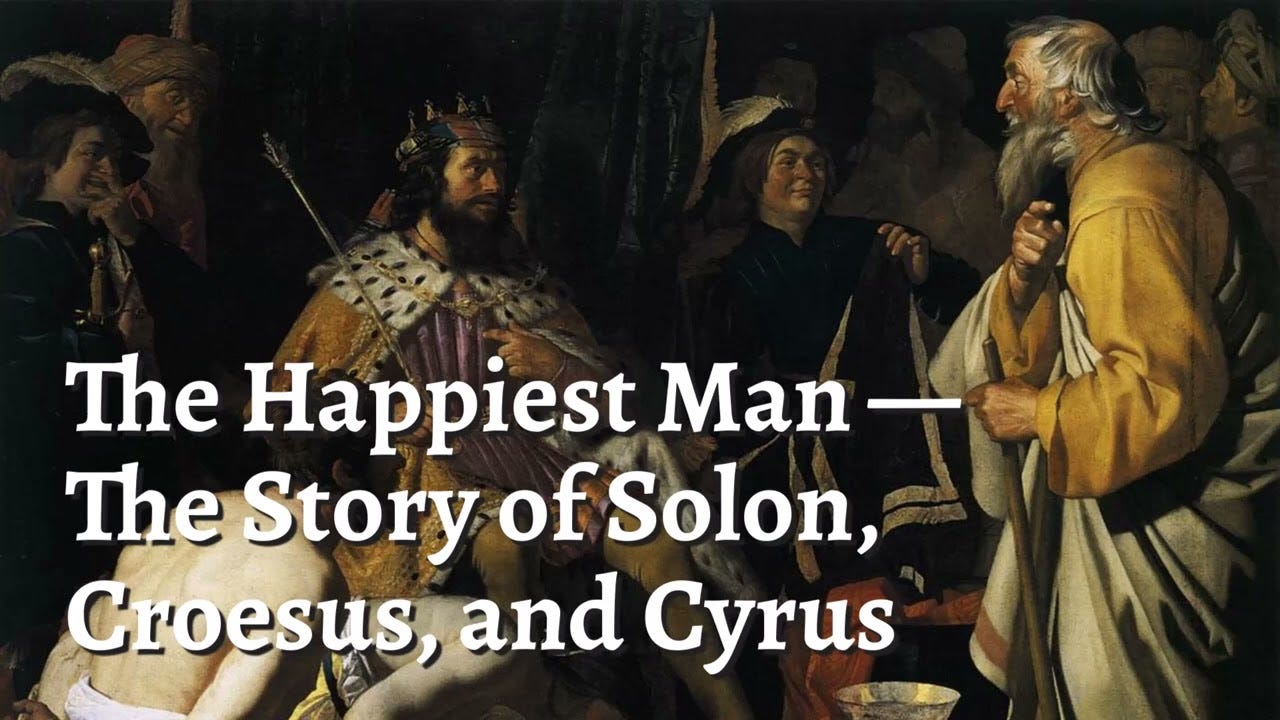
“Now after traveling far and wide and seeing many wonders, Solon arrived at the court of Croesus, king of Lydia, who was said to be the richest man in the world. A most gorgeous court it was, and much visited by travelers, for Croesus was as hospitable as he was rich. He received Solon courteously and entertained him magnificently for three days; after that, he ordered some attendants to take him around the royal treasury and show him everything that was there. Vaults packed with gold ingots; huge piles of ivory, amber, silver; sacks of rubies, pearls, and emeralds; room after room full of armor, vessels, and ornaments all of pure gold and exquisitely wrought — all this and more was displayed to the Athenian stranger. He looked at it all attentively, but said nothing. And when, having seen everything, he was led back to the king’s presence, still not a word did he say about the splendors that had been shown to him.
“Then Croesus, who loved compliments and was expecting Solon to make him a flattering speech, imagined he was tongue-tied by the sight of such vast riches, and resolved to give him a cue.
“‘My Athenian guest,” he said, smiling graciously, ‘your fame as a great traveler and a great observer has reached Lydia before you. I wish therefore to ask you, who is the happiest man you have ever seen?’
“‘Tellus the Athenian,’ replied Solon, without hesitating an instant.
“‘Indeed?’ said Croesus, with a look of vexation. ‘I should have thought… but no matter. May I know why you consider this Tellus, of whom I never heard, the happiest of men?’
“‘Because, in the first place,’ said Solon, ‘he was citizen of a free and well-governed commonwealth — for such was Athens during his time; also, he had good and brave sons, and lived to see their children growing up full of promise. Above all, after enjoying as much happiness as can be looked for by mere mortals, he made a glorious and happy end, for Tellus died in battle for his country, and in the hour of victory. He was buried at the public cost on the field where he fell, and the highest honors were decreed to his memory.’
“‘Your idea of happiness,’ said Croesus, after a pause, ‘is quite new to me, and very perplexing. Perhaps I might understand it better if you were to tell me whom you reckon the next happiest man to Tellus.’
“But in his vanity, he was thinking: ‘Though this uncourtly Athenian will not put me first, he will surely at least put me second.’
“‘Next after Tellus,’ said Solon, ‘Cleobis and Biton, citizens of Argos, are the two happiest persons within my knowledge. You, king of Lydia, will no more have heard of them than of him; but since you desire to hear me further on this theme, I will relate their story…
“‘Argos, a very ancient city, has ever been under the especial patronage of the goddess Hera, who has a famous temple there. Every year, Argives choose a woman of noble family to serve for twelve months as Hera’s priestess; then a great festival is held, during which the new priestess is brought in a car drawn by oxen to the temple, where she dwells during her year of office.
“‘Now Cleobis and Biton were the sons of a noble Argive lady named Praxilla; these brothers were near of an age, and from their birth until they were some eighteen summers old they lacked nothing to make them completely happy. Well-born, and citizens of no mean city, they had a moderate fortune; they had not only sound health but superb bodily strength — already, indeed, they had won glory for Argos by victories in the Great Games…
“‘Such and so fortunate were these two lads, when it befell that their mother Praxilla was chosen Hera’s priestess. Then the roof and crown was set upon their happiness.’
“‘How was that,’ asked Croesus, ‘if they were as happy as they could be already?’
“‘You shall hear, king,’ answered Solon. ‘The house where Praxilla lived with her sons was on a manor she owned, some leagues out of the city, and still more distant from Hera’s temple, which stood on a hill outside Argos. So, very early on the morning of the festival, she made herself ready for her journey. The car was ready also; but by some mistake or negligence of the farm thralls, the oxen that should have drawn it had been driven to work on an outlying field and were already far away. None others could be got near at hand — and no time must be lost, if the priestess was not to arrive too late for the solemn sacrifice at which she must take the leading part… Praxilla wrung her hands in despair and began to weep, but her sons lovingly bade her trust to them and be of good cheer. Then quick as thought they lifted her to her seat in the car and set their necks under the yoke; and putting forth all their youthful vigor, they drew her the whole way to the temple, in good time for the sacrifice.
“‘Now the assembled folk, seeing Praxilla thus brought among them and hearing what the two lads had done, were moved to great admiration. All the men loudly praised their feat of strength; all the women cried: «How blessed is the mother of such sons!» Then Praxilla, in a transport of joy and pride, hurried within the temple and, standing before Hera’s image, she lifted up her hands and prayed thus aloud: «Oh, holy and heavenly queen, vouchsafe now a boon to thy priestess! Forasmuch as my dear sons have so honored their mother this day in the sight of all Argos, grant them, I pray thee, the greatest blessing that the gods can bestow on mortal men.»
“‘Thus she prayed; and the gods, who see with other and clearer eyes than ours, straightway granted her prayer, for when they had joined in the holy rites of the day and shared the joyous banqueting that followed, Cleobis and Biton laid them down to rest that night in a chamber of the temple, and fell peacefully asleep — to wake no more.
“‘In them was made manifest the truth of the ancient saying: «Those whom the gods love die young.» Yes, in the prime of their youth, the height of their happiness, with such fair prospects opening before them, those two were snatched in a moment out of life. Whereby, oh, Croesus, the divine power that rules over all things signified plainly that death is better than life, for man that is born of woman.’
“Croesus listened with what patience he could to the story of Cleobis and Biton; but when Solon made an end of speaking, he burst forth angrily:
“‘Do you hold me so cheap, then, Athenian stranger, though you have seen my power and riches and glory — I say, am I, Croesus of Lydia, the richest and mightiest monarch alive, of such small account in your eyes that you rate obscure and private persons above me in point of felicity?’
“‘Ah, Croesus,’ answered Solon, ‘remember that you have sought my opinion concerning human happiness. And who am I? One who knows the divine power to be ever jealous, ever working change and confusion. One who knows that time in his course brings to every man many things he would fain neither see happen to others nor endure himself — yet must he both see and endure them. And consider this: a man’s life is threescore years and ten; that is, twenty-six thousand two hundred and fifty days, according to our Greek reckoning of months and years. Yet out of so vast a number, not one day is exactly like another. Neither when any day dawns can we tell what it may bring forth. Thus you see, Croesus, we men are but playthings of Fortune.’
“The king still frowned, ill-pleased. Solon regarded him earnestly, and went on:
“‘Be not offended, my royal host, though I cannot speak as you wish, for, though I see you are lord of vast treasures and a great kingdom, I cannot call you a happy man until I hear that you have made a happy end. Nay, I must tell you this — the richest of men is no happier than he who has enough to live in modest comfort, and many a rich man is miserable. My countryman Tellus, and the two Argive lads, of whom I have told you, had but little wealth, though sufficient for their needs. Their blessings were such as I have said —liberty, health, personal strength and beauty, family honor and affection— and in the case of Tellus, good children. But note, Croesus, that even a man who has all these good gifts I call not happy but fortunate — unless they abide with him till his life’s end. For to many a man the divine power shows as it were a glimpse of happiness for a season, and afterward casts him down into wretchedness. We ought, therefore, to call no man happy until he is dead; and before we pass judgment on a life or on anything else, we must look to the end.’
“This discourse of Solon did not lessen the king’s displeasure. Croesus coldly bade him farewell and dismissed him without the mark of royal favor —a gift of gold or jewels— which he usually bestowed on distinguished strangers, for he said to himself: ‘This reputed sage, I find, is a very ignorant fellow — a mere blockhead. Otherwise, he would not shut his eyes to all my glory and grandeur, and prate to me about looking to the end.’
“But Solon, having answered the king according to his judgment and conscience, tranquilly went his way.”
II
“There came a time, however, when Croesus called to mind the words of the stranger from Athens and, with bitter cause, acknowledged that they were words of wisdom.
“Great and powerful as the king of Lydia was, a more powerful and a far wiser king presently arose in the East, and that was Cyrus, king of Persia. This warlike prince no sooner came to his throne than he set about adding new territories to the Persian realm; and soon his conquests reached almost to the river Halys, which was the eastern boundary of Lydia. Then Croesus, alarmed and jealous of his rising power, resolved to make war on Cyrus. But first, being a religious man, he wished to seek counsel of the gods. And having heard the fame of the ancient oracle at Delphi in Greece, where the god Apollo gave response to inquiries by the mouth of his priestess, he prepared to send envoys thither with magnificent offerings: a golden lion, huge bowls and vases of solid gold and silver, and the most splendid jeweled necklaces and girdles of his queen. And the envoys were to inquire of the god: ‘How will Croesus fare, if he makes war on the Persians?’
“But before he sent this embassy, Croesus thought it well to test the truth of the oracle, and this was the test he devised. He sent trusty messengers to Delphi with orders that on the hundredth day from their leaving his city of Sardis, they should demand of Apollo’s priestess what Croesus, king of Lydia, was doing on that day, and bring back her answer in writing. And the messengers returned, bringing this written answer:
“‘I know the number of the sands and can reckon the drops in the sea. I understand the dumb and hear the voiceless. Lo, I smell the mingled savor of a hard-shelled tortoise and of lamb’s flesh boiling together in a cauldron — bronze is the cauldron, and bronze the cover.’
“Croesus no sooner read this response than he fell down and worshipped the god Apollo, for, having thought of something no human being could guess he would be doing, he had gone to the kitchens on the appointed day, chopped up a tortoise and a lamb with his own hands, and boiled them together in a bronze cauldron with a bronze lid. And being thus convinced that Apollo did verily speak through the Delphic oracle, he straightway sent off the envoys with those rich offerings and the question I have mentioned.
“The answer they brought back was in these words: ‘If he makes war on Persia, Croesus will destroy a great empire.’ Whereupon Croesus was overjoyed and, calling his lords and captains together he commanded that his host should be set in array with all speed and march across the frontier to attack the Persians; ‘For the god at Delphi,’ said he, ‘has promised me the victory.’ So Croesus went forth to battle, exulting.
“Now at that time no nation in all the East was more valiant and warlike than the Lydians: their whole army was cavalry, the finest in the world, superbly mounted and trained, and armed with long lances. Cyrus, like the great soldier he was, at first sight of their array knew that his own force, which was mainly infantry, could not stand before their charge, and swiftly he devised a stratagem. He ordered the train of camels that carried the provisions and baggage of the army to be unloaded; mounted some horse soldiers on them, and drew them up in front of his infantry, keeping his cavalry in the rear.
“On came the Lydians at the charge, but their foremost horses no sooner saw and smelled the camels than they wheeled around, terrified beyond all control, and dashing on the squadrons behind them, threw the whole body into wild confusion. Soon a stampede began, as their riders tried to force rearward squadrons to the charge, and more and more horses winded or caught sight of the camels. Those beasts, you see, were new to the Lydians, so they did not know, as Cyrus did, that the horse is horribly afraid of the camel and cannot endure the very smell of one. But when this now dawned upon them, they leaped from their saddles, letting the maddened horses rush away; and gallantly they fought on foot, shoulder to shoulder, against the advancing Persians. But not for long could they make a stand against such odds. Hundreds fell; the rest, Croesus among them, fled back, a broken army, to his city of Sardis…
“Fourteen days later, the Persian king was master of the city, and Croesus, a captive in his hands. Now the citadel of Sardis was strongly fortified and built on a precipitous rock; Croesus had shut himself up there with great store of treasure and provisions, believing that it could hold out many months against a siege; meanwhile, he had sent prayers and lavish bribes to various allies to come and rescue him. And indeed, all might have fallen out as he hoped, but for an accident.
“When Cyrus had besieged Sardis for a fortnight, he let proclaim a large reward in gold to the first man who made his way into the citadel — for he saw it could not be taken by storm. There was one part of the rock so sheer towards the top that it looked impossible to be scaled, and therefore no guard was posted on the rampart above it. The day before, however, a certain Persian soldier had seen a Lydian who was cleaning his armor let his helmet fall over the rampart. It stuck in a bush at the foot of the precipice — and to his surprise, the Lydian forthwith climbed down after it. Very slowly, very cautiously, he made his way down, and up again, feeling with feet and hands for certain projections and crannies of the rockface, which the Persian carefully noted. And next day, hearing of the reward, this soldier climbed up in the same way, followed by two or three comrades; they let down rope ladders, by which numbers ascended; and the citadel being thus surprised, the whole town was quickly taken and sacked.
“Now Cyrus had given strict commands, both before the battle and when he began the siege, that the king of Lydia should be taken alive. But when the Persian soldiers took the citadel and put all the garrison to death, one of them rushed into his chamber and was about to kill him, not knowing who he was. And Croesus, though he saw the sword pointed at his breast, neither spoke nor stirred, but looked at it with utter indifference — so stunned was his mind by sudden disaster. Another instant, and he would have been a dead man. But then a miracle happened…
“There was with him his favorite son, a lad fair in mind and body, but dumb from his birth. For years Croesus had offered untold gold to any that would heal him, and, when all physicians failed, had consulted the Delphic oracle with no better success, for the response was: ‘Oh, foolish king, desire not to hear thy son’s voice in thy palace halls; better for thee that should never betide, for he will first speak in an unhappy house.’ And Croesus in his disappointment had harbored doubts as to the truth of Apollo’s oracle, until he proved it in the way I have told you. But now he was to have a proof yet more wondrous… In the anguish of seeing the sword raised to slay his father, the dumb boy’s tongue was loosed, and he cried out: ‘Man, kill not Croesus!’
“These were the first words he ever uttered, but thenceforward the power of speech remained with him all his life.”
“The poor boy!” exclaimed Linnet. “I am so glad about him — I like that part of the story best. But did the Persian soldier listen to him?”
“Indeed he did,” said Herodotus, “and was greatly frightened to think how nearly he had killed the Lydian king, for which Cyrus would have punished him with death. So Croesus was led a prisoner out of his city and into the Persian camp and brought before his conqueror.
“Now Cyrus, it is well known, was not a cruel man, but one that loved justice and showed mercy even to his enemies. I therefore believe that he had some special reason for what he now did. He caused a huge pyre to be built of logs and faggots, and had Croesus, bound hand and foot with iron fetters, placed upon it to be burned alive. Perhaps he followed ancestral custom by sacrificing such first fruits of victory to the gods of Persia — or he may have been fulfilling a vow — or else, as I think most likely, he may have heard that Croesus was a very pious man, and wished to see whether any of his gods would deliver him. But be that as it may.
“Meanwhile, Croesus seemed still too dazed with misery to heed what was passing; he was placed unresisting on the pyre and stood there like one in a trance while it was being kindled. Suddenly, then, he came to himself, and that same instant the words flashed through his mind: ‘Call no man happy while he yet lives.’ And now he knew they were words of inspired truth. He uttered a deep groan and thrice called aloud the name of Solon. Cyrus, who sat to watch at a little distance, hearing Croesus, as he thought, invoke some god, bade his interpreters go near and ask who it was he called upon. Croesus would not answer for a while; at last, when they urged him, he said: ‘I named a man whose discourse it would more profit all kings to hear than to own all the riches upon earth.’ The interpreters were none the wiser and pressed him to explain; he shook his head and remained silent. Still, they plied him with questions, till at length, wearied by their importunity, he briefly told them how Solon, an Athenian, had once visited him, surveyed his treasures with quiet scorn, and uttered a discourse on the vanity of mortal things which now, too late, came home to his bosom.
“All this the interpreters repeated to Cyrus. And the great king was much moved, reflecting that he, too, was but a man, and subject to like reverses of fortune with the fellow mortal, so lately his equal in power and glory, whom he was destroying. Croesus had wantonly provoked him — yet who could tell whether the high gods, to whom vengeance belonged, might not be wroth with him for presuming to exact it beyond due measure? So thinking, Cyrus commanded his guards to put out the fire instantly and take Croesus down.
“But by this time the base of the pyre was well alight, and, for all the soldiers could do, the flames kept mounting higher. All the water skins in the camp were emptied, and more water quickly brought from a neighboring stream, yet the sappy pine logs and dry brushwood burned even more fiercely. Then Croesus, perceiving that Cyrus had a favor towards him, no longer wished to die; bursting into tears, he cried with a loud voice: ‘Apollo! Apollo! Save thou me now, if ever my offerings at holy Delphi were acceptable in thy sight.’
“Even as he spoke, the clear sky was darkened with clouds; the next instant a heavy shower of rain extinguished the blazing pyre.
“Convinced by this miracle that Croesus was a man beloved of the gods and truly virtuous, Cyrus had him taken down from the pyre, released from his fetters, and set in a seat of honor at his own right hand. Then, addressing him with the respect due to an equal: ‘Who persuaded you, King Croesus,’ he said, ‘to invade my territories, and to become my enemy, instead of my friend?’
“‘Great king,’ answered Croesus, ‘what I have done has been to my own loss and to your gain. The cause of both was that god of the Greeks whom they call Apollo, by whose counsel I went to war. Of myself, I had never done so, seeing that the veriest fool knows that peace is better than war, for in peace, children bury their fathers; but in war, fathers bury their children. However, I suppose it pleased the gods that my enterprise should end in this manner.’
“Now while they talked thus, Croesus lifted up his eyes and saw troop after troop of the Persian soldiery returning to camp, laden with plunder from his city. He watched them awhile in silence, then said: ‘Does it befit me, King Cyrus, to tell you my present thoughts, or rather to hold my peace?’
“‘I am always best pleased with frankness,’ answered the Persian.
“‘Let me ask you, then,’ said Croesus, ‘what those crowds of your soldiery are so busy about, that we see coming and going yonder.’
“‘They are sacking your city,’ answered Cyrus, ‘and plundering your treasury.’
“‘You mean your city and your treasury, oh, king,’ rejoined his captive dryly.
“Cyrus was struck with the wisdom of this remark. He at once ordered his officers and guards to withdraw out of earshot, then: ‘Wise Lydian,’ he said, ‘I take your meaning, and, since you give me friendly counsel, be assured I will treat you henceforth as a friend. Yonder men, as you well observe, are looting property which is now mine by fortune of war. But how am I to stop them? For by our Persian custom, which I hold sacred, my soldiers have the right to pillage a conquered town. Nay, to forbid them now were to risk mutiny.’
“‘Sire,’ replied Croesus, ‘since the gods have made me your servant, it is my duty to advise you as well as I can. Consider, then, that your Persians are as yet a poor nation, but haughty, fierce, and turbulent; to put wealth into the hands of such men is the surest way to breed rebellion. And there is treasure enough in Sardis to enrich your whole army, if you let them take it. So my advice is this: proclaim forthwith that you intend to dedicate a tenth of the spoils of Sardis to your god, wherefore every man must bring whatever booty he has already taken to an appointed place, that the whole may be reckoned. And as far the greater part remains yet untouched, set guards at each gate of the city with orders to prevent any more plunder being brought out until the royal scribes and overseers have made a survey and rendered you an account of all the wealth they find. When this has been done, and the tenth set apart, you can distribute as much of the spoil as you think proper among the soldiers, reserving the rest for yourself. Thus, sire, you may put a stop to their pillaging without offending them. For, being religious themselves, they will revere your piety; and being ignorant in such matters, they can have no idea what vast wealth Sardis contains.’
“Cyrus was delighted with this plan and ordered it to be carried out immediately. ‘I see, Croesus,’ said he, ‘that you are resolved to keep a kingly mind in your adversity. Your giving me good counsel, instead of bearing me malice, shows you are as magnanimous as you are wise. Henceforth you are no longer my prisoner, but my honored guest. And to requite the service you have just rendered me, name what boon you will, and I will grant it, to the half of my kingdom.’ But Croesus said he desired nothing but leave to send his fetters to the god at Delphi, whom he had honored above all gods, and to upbraid him for deceiving one who had deserved so well of him. Cyrus inquired what the deceit was and, having heard the whole story of Croesus’s dealings with the oracle, he smiled and said: ‘You shall obtain not only this, but whatever else you ask of me at any time.’
“So Croesus sent certain Lydians to Delphi on that errand. When they entered the temple, they laid the fetters before the image of Apollo and delivered this message to the priestess: ‘Croesus presents to Apollo these first fruits of the war with the Persians and asks if he is not ashamed of persuading him to that war by a lying oracle that he should overthrow Cyrus. He asks also if it is the nature of the gods of Greece to be ungrateful.’
“Then the Pythia —so the Delphic priestess is called— silently took her seat on the tripod in the inner shrine, whence she delivers her responses; presently the spirit of the god came upon her, and she answered after this manner:
“‘The gods themselves cannot avert the decrees of the Fates. It was ordained that Sardis should fall in the days of Croesus; Apollo therefore could not save it, yet for the king’s sake he prevailed with the Fates to delay its capture for three years. Let Croesus know that he prospered three years beyond his destined hour by grace of Apollo; let him remember who delivered him from the burning pyre. As touching the oracle he received, let him blame his own folly, and not the god, for Apollo foretold that, if he warred against Persia, he would overthrow a great empire. Had Croesus not been blinded by his own conceit, he would have sent again to inquire whether that empire was the Persian or the Lydian.’
“It is said that, on hearing this reply from his messengers, Croesus acknowledged that the blame rested with himself, and gave thanks to Apollo for his mercies, for this once proud king, who had rejected and despised the lesson of Solon, learned wisdom from the stern teacher, Adversity. He grew so wise, indeed, that he became one of the most trusted counselors of the great Cyrus, at whose court he dwelt highly honored until his death.