The Cattle of Helios

💡 This is a chapter from The Wanderings of Odysseus, by C. Witt & F. Younghusband ← Go there to read the full book free online; it is also available in paperback and Kindle editions.
Odysseus and his men were now approaching the island of Thrinacia. This was the pasture of the flocks of the Sun god, and, while the ship was still far out at sea, they could hear the lowing of the cattle and the bleating of the sheep. There were seven flocks of kine and seven flocks of sheep; they were under the care of two of the daughters of the Sun god and, like their master, were immortal: none of them ever died, neither were there ever any young ones added to their number.
Odysseus remembered the warning of Tiresias that misfortune might overtake his companions and himself whilst they were on the island, and said to his men, “Let us avoid this island and go on our way without landing here, for I have been warned by Tiresias that we here stand in danger of meeting with grievous misfortune.”
In reply, the men looked at him despondingly, for they were weary and exhausted; and Eurylochus said, “Hardly art thou a creature of flesh and blood, Odysseus! Thou seemest rather to be made of iron. Thy spirits never fail, neither are thy limbs weary. But we are faint with long rowing and sick with the remembrance of the horrors we have passed through; wherefore then wilt thou hinder us from landing on this island, where we may prepare for ourselves a good meal and enjoy a peaceful sleep? Night, the friend of no man is at hand — the time when storms are wont to arise. Let us therefore sleep here as is fitting, and then in the early morning we will go on our way refreshed.” All the men sided with Eurylochus and urged Odysseus not to grudge them this short rest.
“Against my will ye constrain me,” he replied, “but at least swear to me that ye will eat nothing but the food with which our ship was stored by Circe, and that, if on the island we meet with any flock of cattle or of sheep, ye will refrain from laying hands on the beasts.”
This they promised readily, and then put into the shore; and after they had partaken of a plentiful meal, they stretched themselves on the sand and went to sleep. But towards morning a violent storm arose, which covered the sea with great billows; and they were obliged to draw up the ship on to the shore and hide it in a deep cave to protect it from the unfavorable weather.
Odysseus was much concerned: he feared that, if the storm should continue, they might be compelled to make a long stay upon the island, and that, during this time, his companions might be tempted to break their promise and attack the flocks of Helios. He therefore reminded them again that these animals were the favorites of the Sun god, who sees and hears everything that takes place on the earth, and that anyone who molested them would have to atone for it with his life. The men were astonished that he should think it necessary to say so much about this — had they not abundance of food in their ship? And was it likely that they would be so foolish as to provoke the wrath of Helios?
But the storm continued for a whole month without ceasing, and at last all the provisions were gone. They now had nothing to depend upon for their support beyond the supplies they were able to procure by hunting and fishing, and it was but little that they could obtain in this way; the storm made it almost impossible to fish, and of wild animals there were but few on the island, so that from day to day the spoils they brought in became less and less, and their hunger became greater and greater.
Odysseus shared in their hunger, but still more did he suffer from anxiety lest the calamity of which Tiresias had warned him should now be close at hand. The only hope of help lay in prayer to the gods, and, going to a lonely spot, he washed his hands, according to the Greek custom, and prayed long and earnestly that the gods would point out to him some way of escape. Then he stretched himself upon the grass and soon fell into a deep sleep, quite exhausted with care and grief.
Meanwhile, his companions were sitting together, sad and despondent, for they could see no end to their misery. Suddenly, Eurylochus rose up and said, “Friends, death is terrible in any form, but of all deaths the worst is that by hunger. Therefore, it is my counsel that we slay and eat some of the cattle of Helios. The god will surely be satisfied if we vow to make him amends, and, when we return to Ithaca, we can build a temple in his honor and adorn it with great magnificence. Even should he, in his anger at this deed, destroy our ship when we put to sea again, I for one would rather perish by drowning than tarry here to await a slow death for lack of food.”
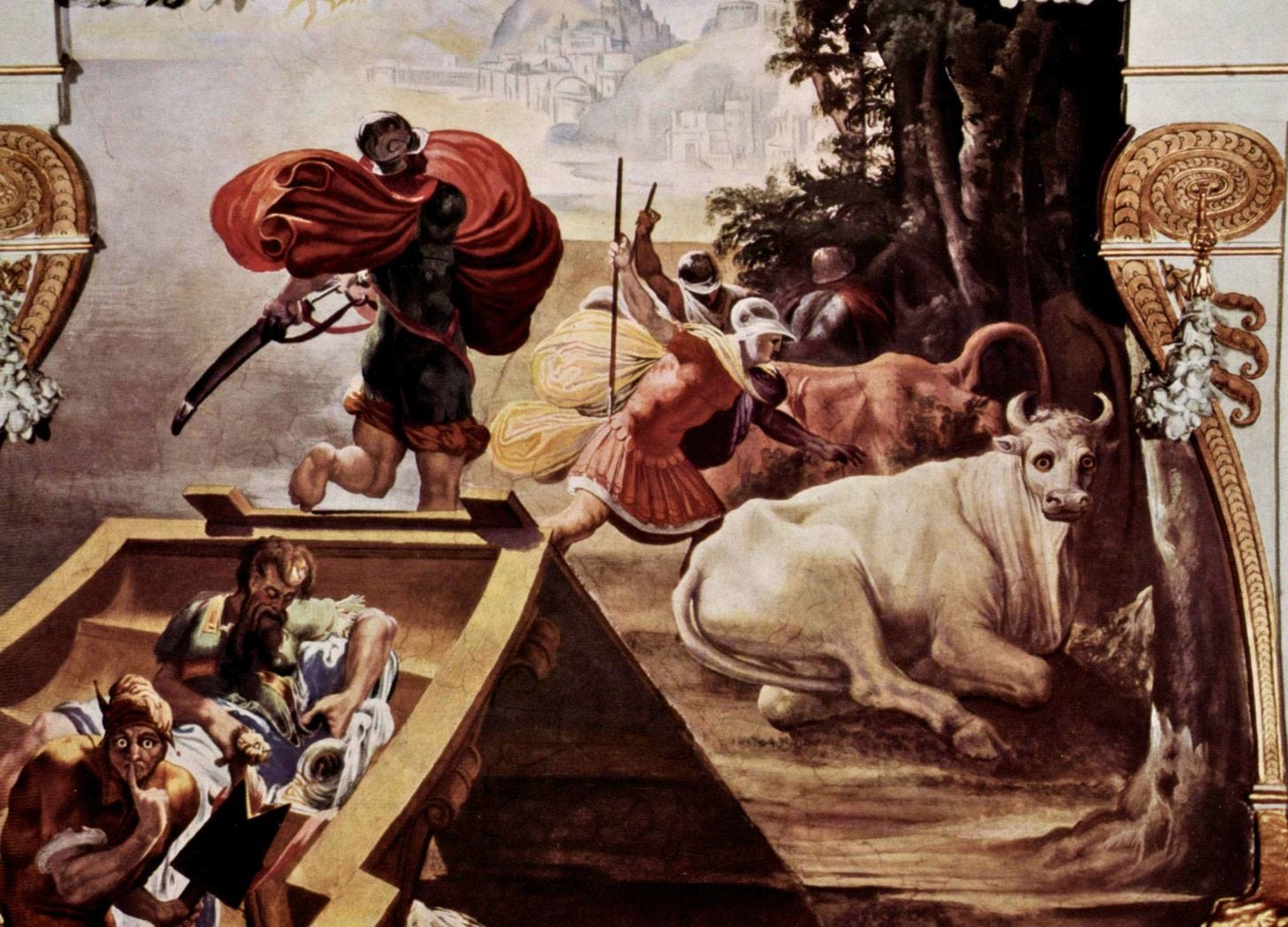
These words went to the hearts of the despairing men; they readily assented to the proposal and, springing up with one accord, betook themselves to the nearest pasture and drove down three fat bulls to the shore.
These they proceeded to sacrifice to the gods, and, as they had no barley with which to bestrew the victims, according to the sacred custom, they plucked leaves from the trees and threw them over their heads and necks whilst the prayer was being said. Then they slaughtered the animals and prepared a meal for gods and men. For the gods the thighbones were always reserved, with the fat and skin belonging to them, and some slices of the flesh besides; this part was laid in the sacrificial fire, and then they fell upon the rest with the eagerness of starving men.
When Odysseus awoke, he hastened back to the camping place, but, even before he reached it, there came to his nostrils the smell of roasted flesh. Nothing more was needed to make him aware of what had taken place, and, sighing deeply, he cried, “Father Zeus and ye other gods, it is for the undoing of us all that ye have caused me to fall into this sleep, during which my companions have burdened themselves with so heavy a crime!” Bitterly he reproached his friends for what they had done, but it was now too late to mend the evil.
The gods immediately manifested their anger by signs that could not be mistaken: the skins of the cattle which had been flayed rose up and walked away as if they were living animals, and the flesh which was being roasted on spits before the fire bellowed and roared. The gods also decided that punishment should quickly overtake the guilty men. One of the daughters of the Sun god, who had charge of the flocks, had ascended to Mount Olympus as soon as the robbery was committed, and told her father of the crime.
The anger of Helios was immediately roused, and he said to the other gods, “The companions of Odysseus have killed my cattle, which it has been my delight to look upon as often as I have driven across the heavens. They one and all deserve death. Promise me that my right shall be upheld, or I will go down to the Lower World and henceforth enlighten the Land of the Dead.”
To which Zeus made answer, “Shine on, Helios, as of yore, in the sight of gods and men; soon will the ship of Odysseus be again in the open sea, and then I will send a flash of lightning to destroy it.”
The storm continued for six days longer, and during that time the companions of Odysseus lived upon the cattle of the Sun god. On the seventh day, the weather cleared, and they pushed out the ship to sea and left the island. But they made little progress, and soon a black angry-looking cloud swept over the sky — the forerunner of a tremendous storm. The ship was tossed up and down upon the waves, which rose as high as mountains; and the wind tore violently at the ropes and sails. Soon the two ropes which held the mast in its place gave way, and it fell upon the helm with a crash, killing the steersman and sweeping him overboard. Then, after a peal of terrific thunder, there came a flash of lightning which struck the ship. It went reeling over onto its side, and then with a violent lurch swung back again, tossing all the companions of Odysseus out into the sea. For a short time, they could be seen on the surface of the water like so many seabirds — then they were engulfed by the waves, never to rise up again.