Achilles and Patroclus: Cousins or Lovers?
The relationship between Achilles and Patroclus changes depending on the sources...

The relationship between Achilles and Patroclus changes depending on the sources (including the famous movie Troy with Brad Pitt as Achilles). Let’s answer three questions:
Were they lovers?
Were they cousins?
Which of the two was the older?
Were Achilles and Patroclus Lovers?
In the Homeric poems, nothing is ever known to confirm or deny it; however, in the Iliad the two appear sleeping with women (which does not preclude the possibility that there was something more between them).
Already since the 5th century B.C., the Greeks had been thinking about this relationship in which Achilles was the lover and Patroclus was the beloved, that is, active and passive, respectively.
This would contradict the fact that, despite what is usually thought, Patroclus was older than Achilles, so it would have been his part to be the lover.
Were Achilles and Patroclus Cousins?
In the movie Troy (2004), Patroclus is presented unequivocally as Achilles’s younger cousin. Is this merely a puritanical device?
Achilles, as is well known, is the son of Thetis and Peleus.
Patroclus is the son of Menoetius and a mother that varies according to the sources.
This Menoetius was the son of Actor and Aegina.
This Aegina had previously had Aeacus with Zeus.
This Aeacus was the father of Peleus (father of Achilles).
The conclusion is that Aegina was the mother of Menoetius and the grandmother of Peleus, so the bottom line conclusion is that, rather than them being just cousins, Patroclus was Achilles’s cousin-uncle.
Which of the Two Was the Older?
We have already anticipated that indeed Patroclus was older than Achilles. This is made very clear, for example, in Plato’s Symposium, which in turn cites Homer himself as its source:
[Achilles] had not yet grown a beard, so he was much younger, as Homer states.
Plato, Symposium 180a
And we now quote Homer, who says the following explicitly:
My child, in birth is Achilles nobler than thou, but thou art the elder though in might he is the better far. Yet do thou speak to him well a word of wisdom and give him counsel, and direct him; and he will obey thee to his profit.
Homer, Iliad XI (translated by Murray)
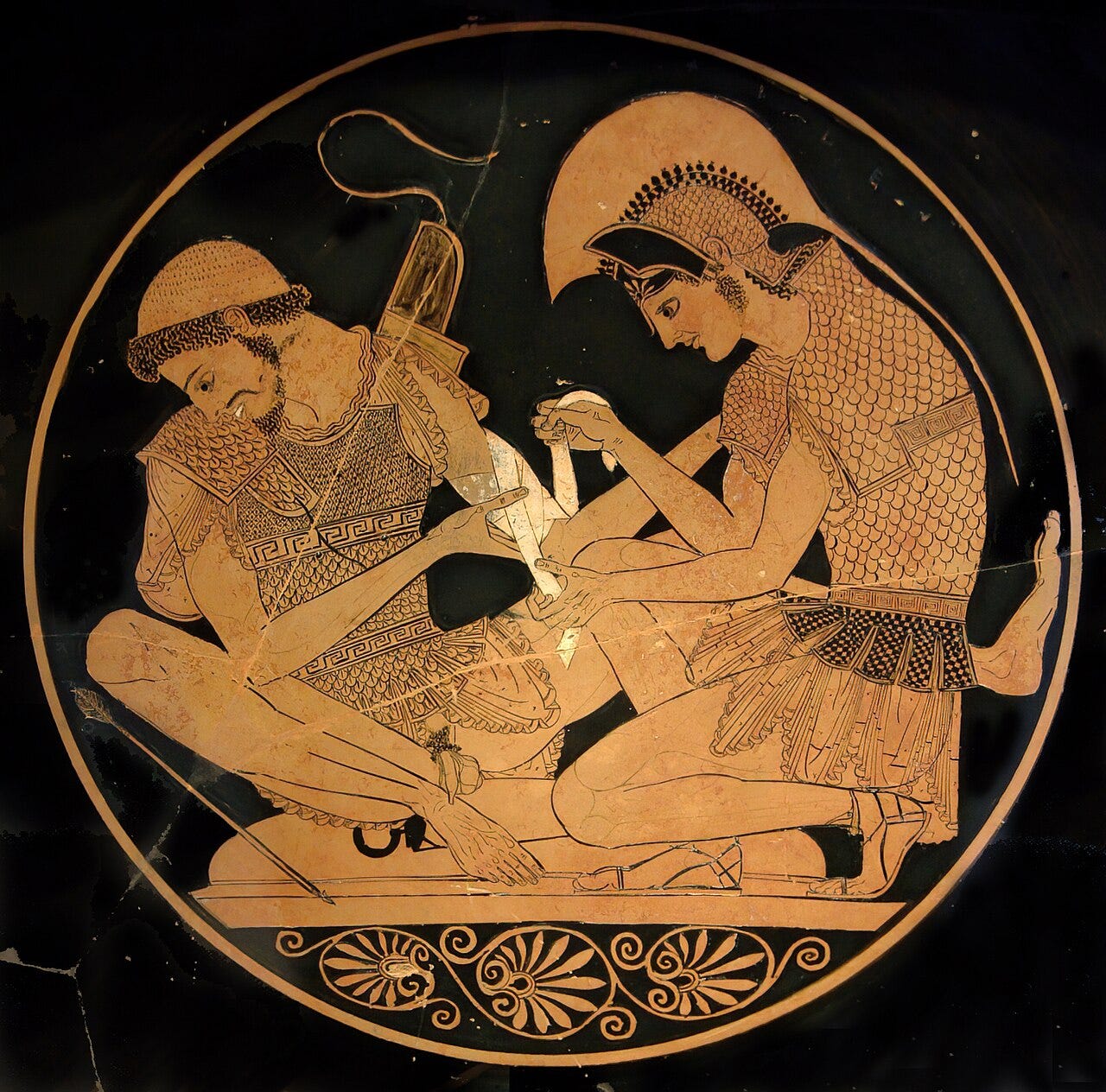
The difference between a bearded Patroclus and a beardless Achilles can be clearly seen in the famous kylix usually known as “Achilles tending Patroclus wounded by an arrow”: Achilles (no beard) is the one healing Patroclus (with it).